

AI-Generated Images in News Coverage: How to Spot Them
A photograph has long worked like a receipt. Something happened, someone was standing there, and a frame of it survived. Readers still grant pictures that authority without thinking about it. Producing a believable image, though, no longer requires being anywhere near the scene. The gap between what a picture looks like and what it proves is where most of the trouble now lives.
None of this means you should distrust every photograph you see. It means the checks news desks have used for years — the file, the source, the light, the record — are worth borrowing. Most take under a minute.
The visual tells: what still looks wrong
Detection is a moving target. Giveaways get fixed in the next round of models, so treat these as a quick sieve rather than a verdict.
- Hands and feet. Fingers that merge, an extra knuckle, a thumb arriving from the wrong side, shoes dissolving into pavement.
- Text. Signs, shopfronts, T-shirt slogans, number plates and badges are the classic failure point. Letterforms drift into nonsense, or into script from no alphabet you recognise.
- Background crowds. Faces that repeat, bodies that end too early, a person whose head sits behind a pole while their hand is in front of it.
- Accessories. Glasses frames that never reach the ear, jewellery that fuses with skin, one earring and no other.
- Edges and textures. Hair fraying into fog, teeth arriving in odd numbers, a fabric pattern that shifts as it crosses a fold.
- Reflections and shadows. Two people casting shadows in different directions, or a window reflection showing a street that isn't there.
Note the direction of travel. The clumsy tells are getting rarer, and the remaining ones are quieter. A picture can now be technically flawless and still be fabricated.
Read the light and the physics
Photographers work with light; synthetic images are often composed around a subject and lit afterwards. So ask where the sun is. Follow a shadow back to its source. Check the reflection in a pair of sunglasses or a car window — it should agree with what is behind the camera, not with what is in front of it.
Then look at the finish. Real news photographs are usually a little untidy: motion blur, grain, a nose out of focus, somebody blinking, a stray arm at the frame edge. Images built to be striking can be too clean, with skin that has no pores and a depth of field that never makes a mistake. Polish alone proves nothing, but alongside a suspicious caption it is worth noting.
Ask what the picture is doing
Melodrama is a clue. A photograph that lands the perfect emotional beat — the single tear, the flag at exactly the right angle, the heroic silhouette — deserves a second look. Not because strong pictures don't exist, but because they are hard to make and easy to manufacture.
Look inside the file
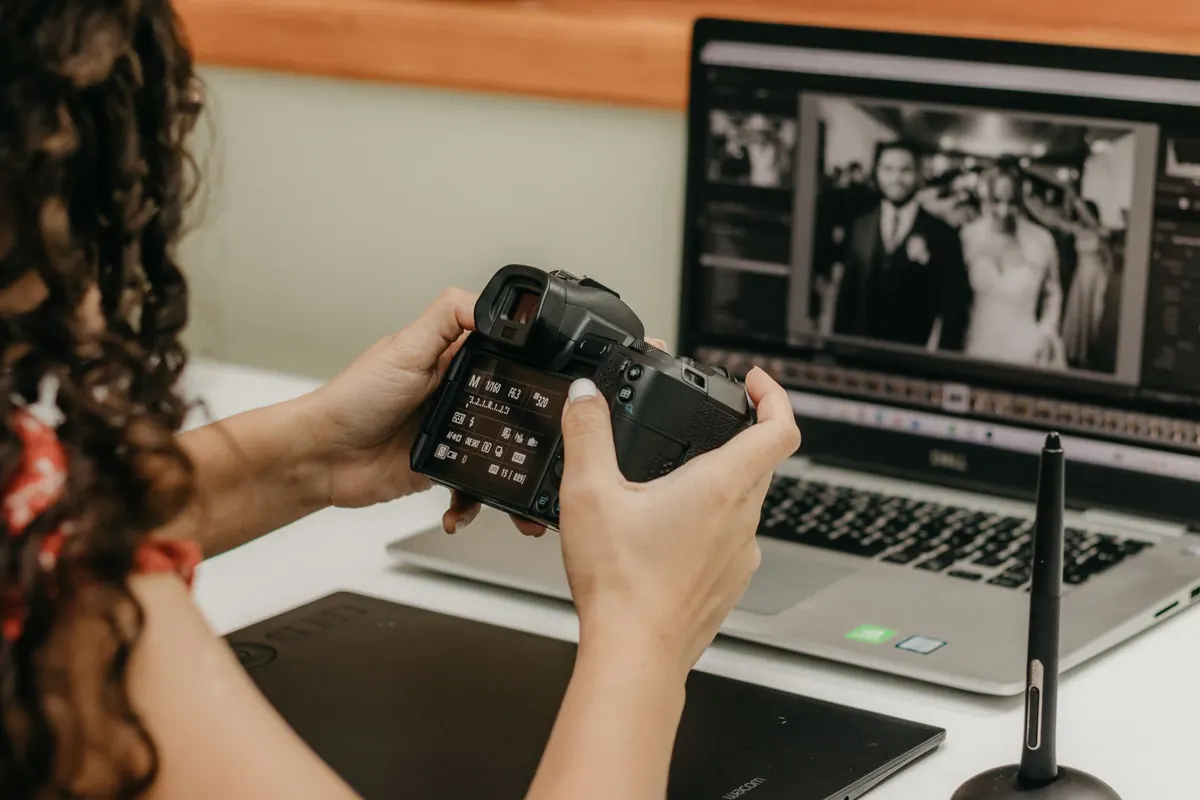
Photographs from a camera or phone carry hidden data: make and model, lens, shutter speed, ISO, sometimes a date and a location. On a Mac, select the file and press Command-I. On Windows, right-click, choose Properties, then the Details tab. Most phone gallery apps have an info or details option. Editing software often leaves its own trace in the same panel.
Treat all of it as evidence, not proof. Platforms strip metadata on upload, so a missing camera record proves nothing, and screenshots have none by design. Metadata can also be edited as easily as a caption. What you want is a story that holds together: a plausible camera, a plausible timestamp, and no editing trail that contradicts the claim.
File details help in duller ways too. Odd dimensions, a heavy square crop, a filename that looks like a download rather than a camera's naming convention — small frictions suggesting the picture has travelled a long way from wherever it began.
Run a reverse image search
- Save the picture and upload the file itself, not the page. Try Google Lens, TinEye, Bing Visual Search and Yandex. They index differently, and one may return nothing while another returns plenty.
- Crop to the most distinctive part and search again. A building, a badge, a street sign or a face often works better than the full frame.
- Read the earliest result. Find the first appearance you can, check its date, and compare the caption there with the claim you were sent.
- Look for the same image in other contexts. If it turns up as a flood in one country, a protest in another and a snowstorm in a third, you have your answer.
- Search the caption text as well. Newsrooms that carried a genuine, striking image will still have it on their sites.
Check the source before the pixels
Provenance beats forensics. A named photographer, a wire service credit, an agency, or a newsroom with a published corrections policy is a reasonably strong signal. A cropped screenshot with the credit removed is not. Look for the original post rather than the version that reached you, and stay alert to how images travel: a picture from six years ago resurfacing as this week's news is one of the most common forms of visual misinformation, and one of the easiest to catch.
Ask, too, whether anyone else is carrying it. Genuine, striking pictures are picked up by many outlets within hours and moved to subscribers on the wires. An image that exists only in one account, shared widely and credited to nobody, should be held at arm's length.
Some real photographs mislead anyway
The most common problem is not a fabricated picture but a real one with a dishonest caption. Cropping removes context. A photograph from a different year or a different city can be presented as current and local. A staged scene can be shot to look candid. All of it survives every metadata check, because the file is genuinely untouched.
Which is why the caption deserves as much scrutiny as the image. Who says this is where and when? What would we see just outside the frame? Does the wider record — other photographs, local reporting, official statements — support the claim?
A short routine you can run in a minute
- Scan the hands, the text and the background edges.
- Find the light source and check that the shadows agree with it.
- Open the file details and see whether anything contradicts the caption.
- Reverse-search the image and the caption, then find the earliest version.
- Identify who took it and who published it first.
- If it is doing something dramatic and you cannot confirm it, don't pass it on — say what you can't verify.
That last step matters more than the rest. Sharing a doubtful picture with a cautious caption still spreads it, and the picture will outrun the caveat every time. The photograph remains evidence. It just needs a witness.
Photo: Kawê Rodrigues / Pexels